
Roadrunner Cash is New Mexico's $1 five-from-37 draw game, with a nightly drawing and prizes for matching two through five numbers. Its top prize starts at $25,000 and grows until won, with estimate and sharing rules that matter when reading a jackpot advertisement. This guide explains costs, odds, result checks and claims, using facts checked November 17, 2026.
Understand Roadrunner Cash as New Mexico's five-number game
Roadrunner Cash is a New Mexico-only draw game in which one play contains five different numbers selected from 1 through 37. A regular play costs $1 for one drawing. Match at least two of those numbers to reach a prize category, with all five matching numbers needed for the top prize. The jackpot starts at $25,000 and grows until won, subject to the official prize rules.
The five selections form a set. They are not five separate digit positions, and there is no extra Powerball-style special ball to select. This matters when a general search for Pick 5 leads you to Roadrunner Cash: a five-number jackpot game and a five-digit daily game have different entry formats, matching methods and odds. Check the name on the printed ticket rather than choosing a tool solely because its title contains five.
For a hypothetical example, a valid selection could contain 2, 9, 17, 28 and 36. These are five different values in the permitted range. A second copy of 9 would not create another distinct selection in that set, while a number outside 1 through 37 would not fit this game's matrix. This example explains the format; it is not a recommendation or a report of a winning draw.
The New Mexico results hub separates Roadrunner Cash from the state's Plus games and national jackpot games. Identify the correct game first, then read its date and prize information. A larger headline jackpot elsewhere on the same page belongs to that other game and cannot be used to calculate a Roadrunner Cash prize.
This guide explains the rules checked on November 17, 2026. It does not publish a supposedly current jackpot without a dated official drawing record. Understanding what the entry contains makes the next choices clearer: how many paid plays you want, which drawings they cover and what total cost you are agreeing to before purchase.
Choose a play and calculate its full price
Write the purchase as a multiplication: number of plays, multiplied by number of drawings, multiplied by the $1 basic price. Three selections entered for four drawings cost $12. That total concerns twelve paid entries, even if they are grouped on one piece of paper. Establish the full amount before choosing extra panels or future dates.
Quick Pick and personal selections use the same drawing
Quick Pick lets the lottery terminal choose the numbers. Choosing them yourself lets you decide the valid set. Both methods enter the same game and have the same mathematical chance for any particular five-number combination. A birthday, a balanced-looking set, a recent winner or a computer-generated selection does not receive special treatment in the drawing.
Use whichever selection method is convenient while checking the printed result of the purchase. A marked playslip or a saved set of favorite numbers is an instruction or reminder, not evidence that an entry was issued. Confirm the game name, all five numbers, draw date and cost on the actual ticket. If something differs from what you intended, address it with the retailer immediately rather than discovering the discrepancy after the drawing.
Multi-Draw repeats a paid entry
The official instructions allow the same selection in up to 14 consecutive drawings using Multi-Draw. The $1 price still applies to each play in each drawing. Two selections across fourteen drawings therefore cost $28. Multi-Draw saves repeated purchase steps; it does not make the additional drawings free.
Each drawing is a separate event. Matching two numbers on Monday and three different numbers on Tuesday does not combine into a five-number jackpot match. A purchased entry must match the winning set from its own drawing. Keep the original ticket through every drawing it covers and track each date individually when checking it.
Players must be at least 18. Set an entertainment budget for the whole purchase, including future dates, and avoid increasing it to recover a previous loss. LotterySnap does not sell entries or accept wagers. A guide can explain price and coverage, but it cannot make a losing set due to win or guarantee that buying more plays produces a prize.
Check the nightly schedule in Mountain Time
Roadrunner Cash drawings take place every day at approximately 9:30 p.m. Mountain Time. The current official game page lists ticket sales until 9:30 p.m. for that night's drawing, with sales for the following drawing resuming at approximately 9:35 p.m. The short break separates two different entries in the schedule; it is not a second Roadrunner drawing five minutes later.
Read the draw date printed on a purchase made around that boundary. A ticket issued after sales reopen concerns the next drawing, even though the calendar on your phone may still show the same evening. Confirm the actual ticket rather than assuming that any purchase made on a particular date belongs to that date's completed draw.
Use the game's Mountain Time reference when travelling or checking from another region. In November standard time, 9:30 p.m. MST corresponds to 11:30 p.m. Eastern, 10:30 p.m. Central and 8:30 p.m. Pacific. Keep the applicable time zone and date together when translating a schedule. A screenshot that says tonight without naming a time zone is a poor reference for buying or checking an entry.
Historical official stories can contain an older schedule. For example, an archived promotion may describe a different time or a Monday-through-Saturday drawing pattern. That does not override the present game hub's seven-days-a-week schedule. Check the current operator page and any current notices when an old guide conflicts with it.
The drawing time is also different from the moment a particular website finishes updating its display. The operator says numbers are posted after the drawing; this guide does not promise an exact publication delay. If the latest card still has the previous date, wait for the correct dated record or use the official result channel. Reusing yesterday's numbers because the new draw has already been scheduled is not a valid ticket check.
Compare the four prize tiers and their odds
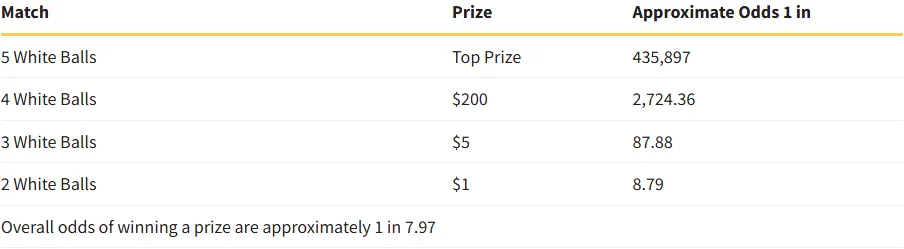
The current official chart lists four winning categories. Read the number of matching selections for one paid play, rather than combining matches across different panels. Four matching numbers on one play qualify for a different category from two matching numbers on each of two other plays.
| Matching numbers | Listed prize | Approximate odds |
|---|---|---|
| 5 of 5 | Top prize | 1 in 435,897 |
| 4 of 5 | $200 | 1 in 2,724.36 |
| 3 of 5 | $5 | 1 in 87.88 |
| 2 of 5 | $1 | 1 in 8.79 |
The jackpot is a changing, potentially shared amount. The lower amounts are the chart's listed prizes, with the operator's qualification that some or all can become pari-mutuel under the circumstances in the rules. Read that qualification alongside the table rather than treating a copied list of dollar amounts as an unconditional payment promise.
Overall odds do not describe the jackpot chance
The overall chance of any listed prize is approximately one in 7.97. That includes the $1 match-two category. On a $1 play, a $1 prize returns the basic entry price before considering other purchased plays; it is not a net gain of another dollar. The jackpot chance remains one in 435,897 for a single valid combination.
There are 435,897 different five-number sets available from 37 numbers. Because order does not distinguish an additional set, counting 2-9-17-28-36 and 36-28-17-9-2 as separate jackpot outcomes would overstate the possibilities. This is why the game's combination count differs from multiplying 37 by itself five times.
One-in-7.97 is a long-run probability description, not a promise that your eighth entry wins. A run of losses does not create a winning obligation in the next drawing. Frequency tables can summarize previous outcomes, but a number labelled hot or cold receives no extra mathematical chance in a fair future draw. Set your spending limit independently of such labels.
Buying different combinations covers additional outcomes while increasing cost. Repeating the same combination does not create a new distinct jackpot outcome for that draw. If comparing purchase plans, distinguish the number of paid entries from the number of different sets covered; neither description guarantees a profit or removes the game's uncertainty.
Read an advertised jackpot as an estimate and shared prize
The starting top prize is $25,000, and it grows until won. That rule does not mean every current drawing offers exactly $25,000. When checking an advertisement, identify the drawing date and whether the amount concerns the next drawing or a completed one. A search result can preserve an earlier estimate long after the next jackpot has changed.
The operator describes the advertised jackpot as an estimate funded by game sales. Its current notice says the advertised amount is paid when generated sales are sufficient to fund it within five percent either way. When sales fall outside that funding range, the actual amount is paid. This qualification explains why the large promotional figure is not an unconditional guarantee of the final pool.
The top prize is also pari-mutuel: two or more winning tickets share the amount. For a purely hypothetical illustration, if the final validated pool were $200,000 and there were two equal winning ticket shares, each share would be $100,000 before any applicable claim or tax processing. That example is not today's jackpot, and the advertised estimate alone would not establish its assumed final pool.
When a winning story quotes a person's payment, compare it with the number of winning tickets and the actual drawing. A smaller individual amount can reflect a shared top prize rather than a different set of winning numbers. Keep that explanation separate from whether a person bought a single entry, a multi-draw ticket or participated in a group; those details need their own evidence.
The current How to Play page also warns that lower prizes may become pari-mutuel under circumstances in the game rules. Do not transfer the separate Pick 3 Plus or Pick 4 Plus tier limit into Roadrunner Cash. They are different games with different prize structures. If a payment differs from a simplified table, use the official record for the exact drawing and ask the Lottery to explain the applicable rule.
For a live purchase or ticket check, return to the official game page and read the dated estimate or completed result. A historic record jackpot, a cached countdown and a current validated winning amount are three different pieces of information. Keeping their dates and roles clear is more useful than choosing whichever number is largest.
Match your ticket to the correct drawing and result
Read the ticket's game name and drawing date before comparing its numbers. The Roadrunner Cash results page provides a game-specific place to begin. Check the date beside the result, particularly around the nightly update. A card showing the most recently available record should not be relabelled as a future drawing simply because your ticket is already valid for that next date.
Evaluate each paid play separately. Count its matching numbers against the one applicable winning set, then look at the appropriate prize category. Do not assemble a five-number match using two numbers from one panel and three from another. The fact that both panels appear on the same ticket does not merge their selections into a single entry.
Number order and an old result can cause different mistakes
Roadrunner Cash matches a number set rather than requiring the displayed order. Suppose an illustrative ticket contains 2, 9, 17, 28 and 36, while the illustrative drawn set is 9, 17, 21, 28 and 35. That play has three matches: 9, 17 and 28. Sorting the displayed numbers differently does not change the count. Neither set is presented here as an actual result.
A correct-looking match against the wrong date is a different error. Reordering your ticket cannot fix a comparison with yesterday's drawing. Return to the date and game label whenever a result looks unexpectedly generous or seems to contradict another source. Also confirm that you have not copied a bonus or special ball from a national game shown nearby.
The LotterySnap number checker compares entered numbers with its available drawing records. It does not scan a ticket barcode, establish ownership or authorize payment. If you cannot select the exact game and drawing you need, use the relevant official results and validation route rather than forcing the entry into another game's settings.
Keep a multi-draw ticket until every purchased drawing has been checked and any claim question is resolved. Record which dates you have reviewed so a second visit to the archive does not leave you guessing. A saved result screenshot can document the comparison, but the original paper ticket remains essential for the official claim process.
Claim a validated prize before the New Mexico deadline
Sign your original ticket and protect it from damage. The New Mexico Lottery describes an unsigned ticket as a bearer instrument. Keep any personal record secure, and avoid sharing clear photographs of the barcode, serial information or signature online. A comparison result on a website does not establish who owns the physical entry.
Draw-game prizes must be claimed within 90 days of the drawing, or the first business day afterward if the Lottery is not open on the ninetieth day. The official draw-game rules require a mailed ticket to be received within the applicable deadline. A postmark at the end of the claim period does not establish timely receipt. Check an old ticket promptly rather than waiting for a convenient later trip.
The current official claim page separates the routes by validated prize amount. Prizes up to $600 may be claimed at a New Mexico Lottery retailer or by mail without a claim form. Prizes from $601 through $99,999 require headquarters or a mailed claim with the completed form. Prizes of $100,000 or more must be claimed in person at headquarters.
Choose the route using the actual validated prize, including any official sharing adjustment, rather than an advertised jackpot headline. Before mailing, obtain the current form and address directly from the Lottery and keep a record of the documents sent. Before travelling, confirm operating hours and holiday arrangements. This is general information, not a personal legal or tax recommendation or a promise of immediate payment.
If a ticket will not validate or the reported prize differs from your calculation, retain the original and ask the Lottery for an explanation of the exact drawing and entry. A damaged code, a wrong date and a shared prize are different issues. Clear details about the game, date and purchased plays help resolve the question more effectively than repeatedly trying unrelated online scanners or changing the numbers entered into a checker.

Loading comments...