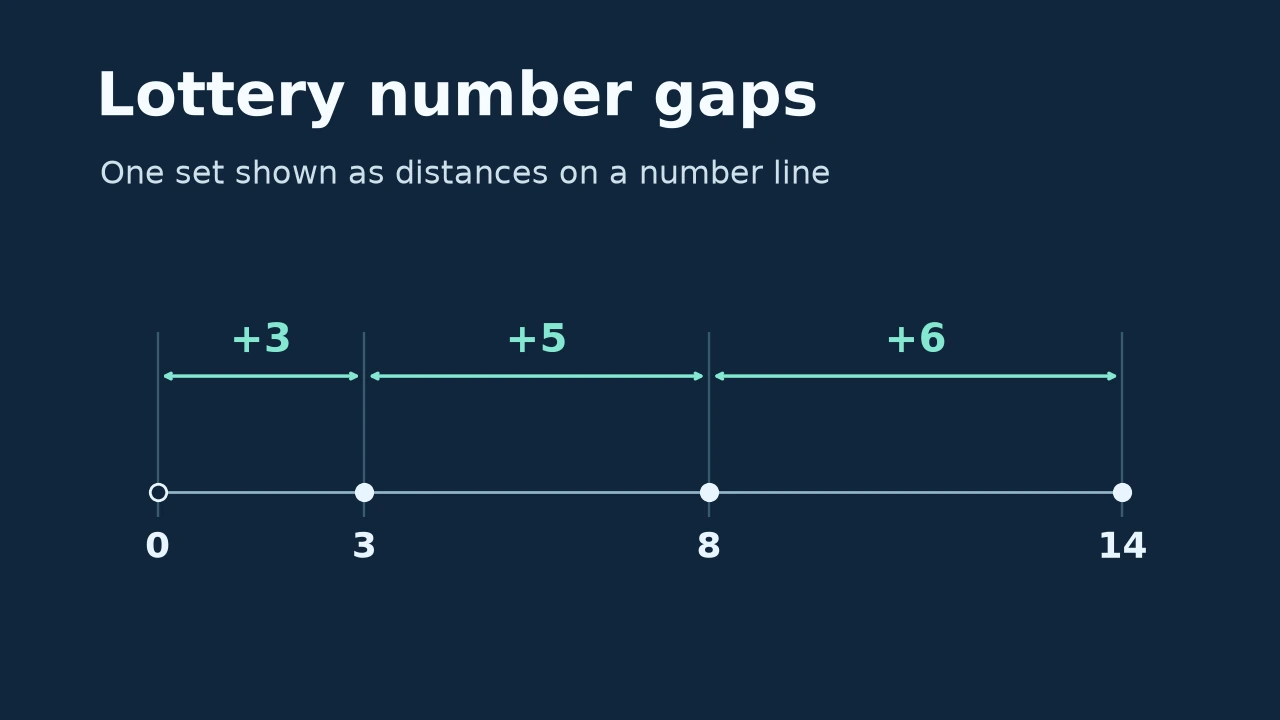
A Delta Lotto system calculator shows the gaps between sorted lottery numbers. Start with the smallest number, keep the distance between each pair, and you can reconstruct the same set by adding the distances. The format can make a result easier to describe. It gives a fixed valid line the same chance of matching the next fair draw as any other valid line.
Use the examples below to work out the gaps, reverse the calculation and see why a common pattern may cover many possible results while a single line still covers only one. The game rules determine which numbers belong in that calculation.
What a delta lotto calculator measures
A delta calculator expresses one set of lotto numbers as distances along a number line. Suppose a game draws distinct main numbers and their order makes no difference to a match. Sort the numbers from smallest to largest, then subtract each number from the one to its right. In this guide the first entry is the distance from zero to the smallest number. The other entries record the distance between each successive pair. Mathematicians call this kind of subtraction a successive difference. UCLA classroom handout on successive differences
Consider the invented set 3, 8 and 14. The gap from 0 to 3 is 3, the gap from 3 to 8 is 5 and the gap from 8 to 14 is 6. The gap display is therefore 3, 5, 6. A tool using separate fields could show “start 3” and “gaps 5, 6” for exactly the same set. Both displays keep enough information to recover all three numbers. In a game whose smallest allowed value is one, zero serves as a reference point on the number line.
Look for that first value when you copy numbers from a calculator or a spreadsheet. If a display reports only the internal gaps 5 and 6, the starting position is unknown. The numbers 4, 9 and 15 also have interior gaps of 5 and 6. You could shift the whole shape again so long as the new set stays within the allowed range. The initial entry is what tells you where the shape begins.
Some tools may report overall spread alongside the gaps. In this example the highest main number is 14 and the lowest is 3, so the spread is 11. It is the sum of the two inside gaps, 5 and 6. The sum of all three entries, including the distance from zero, is 14. Keeping those two totals straight makes it easier to spot a calculator using an unfamiliar convention. The same arithmetic can describe a published set from yesterday or a fictional set you typed in today. In either case, the output describes whichever values went in.
How to calculate and reverse lottery deltas
Try a fictional line of five distinct numbers in an illustrative field of 1 through 50. The numbers are 28, 4, 37, 11 and 19. You can do both directions of this calculation on paper. Use the five main values alone and write the game’s permitted range beside the example so you can check it again at the end.
Convert the numbers to gaps
Put the five values in ascending order to get 4, 11, 19, 28 and 37. Write zero to their left as a reference and subtract within each adjacent pair. Do the subtraction from the original sorted row every time. After you calculate 11 minus 4, use 11 as the earlier value in the next pair. Reusing the gap of 7 as the next starting point would instead measure the wrong interval. This procedure yields 4, 7, 8, 9 and 9. Both gaps of 9 are valid because they describe different pairs of numbers. NumPy documentation for the adjacent difference operation
| Position | Subtract adjacent values | Gap | Total after adding the gap |
|---|---|---|---|
| First | 4 − 0 | 4 | 4 |
| Second | 11 − 4 | 7 | 11 |
| Third | 19 − 11 | 8 | 19 |
| Fourth | 28 − 19 | 9 | 28 |
| Fifth | 37 − 28 | 9 | 37 |
Add the gaps to recover the numbers
To turn the gap list back into the original values, start at zero and add one gap at a time. Record the total after each addition. The first total is 4, then 4 plus 7 makes 11, 11 plus 8 makes 19, 19 plus 9 makes 28, and 28 plus 9 makes 37. In each step, adding a gap back to the earlier number undoes that step’s subtraction. This running total is also called a cumulative sum. The final total is the largest original main number, which gives you a quick check when both lists are on screen. NumPy documentation for cumulative sums
Keep the gaps in their original sequence. Swapping the 7 and the 8, for example, leaves the final total at 37 but moves the second recovered value from 11 to 12. If you need to check that every number matches, compare the full list of cumulative totals. If a tool stores the first number separately, begin with that number and then add the four internal gaps, preserving the same order.
Spot an invalid gap sequence
For the example game, there should be five positive whole-number entries when you count the distance from zero. Replacing the third gap with zero would leave the total at 11 and repeat a main number. A negative gap would move backward and would no longer represent an ascending set. The five entries must fit within the range as well. Changing the final gap from 9 to 24 gives a last number of 52, which exceeds 50. A final gap of 22 gives exactly 50 and stays within the range.
Watch for an extra field after the last gap. A worksheet can also show the distance from the last number to the upper limit, which is 13 in this example if the limit is 50. Treat it as a boundary measurement if that is how the worksheet labels it. Adding that field as another gap would decode an extra number. If any field is unclear, check how many main numbers the game uses and compare the reconstructed row with the original one.
Why common gap patterns do not improve the odds
In a fair drawing of distinct main numbers from one pool, every possible set of the required size has the same chance. The complete ordered gap list with its starting value identifies exactly one of those sets. Every valid set has exactly one complete gap list under the same convention. Changing your notation leaves the number of possible outcomes unchanged. A broad description like “the two numbers are adjacent” can happen much more often because several outcomes fit that description. Durham University notes on equally likely outcomes
Count patterns and individual lines separately
Say a fair toy draw picks two distinct numbers from 1 through 5, with order ignored. There are 10 possible pairs. Four of them have a gap of one: 1 and 2, 2 and 3, 3 and 4, and 4 and 5. A gap of two spans three possible pairs because the lower member can be 1, 2 or 3. A gap of three allows two possible starting points, and the gap of four belongs only to 1 and 5. This is enough to make the gap of one four times as common as the gap of four in the model.
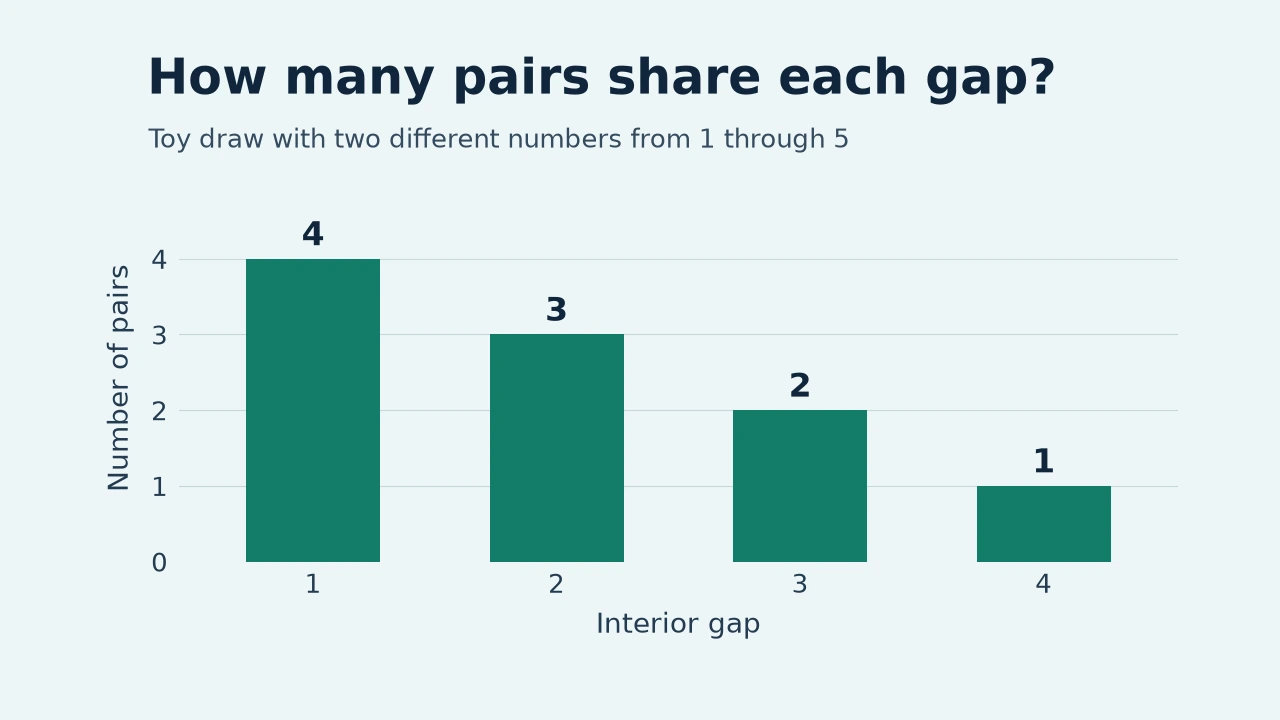
Before the draw, 1 and 2 still has a one-in-ten chance. So does 1 and 5, even though the broader category that contains 1 and 5 is smaller. If someone tells you after the draw that the gap was one, then you have new information and can narrow the answer to four pairs. A calculator that merely displays gaps has no such information before the draw. This is the difference between counting every outcome in a category and identifying one outcome that meets all the requirements for a jackpot. OpenStax examples of probability and combinations
Compare the result with published jackpot odds
For a complete Powerball play, count the 11,238,513 ways to choose five different white numbers from 69, then multiply by the 26 possible red Powerball values. That makes 292,201,338 complete outcomes. Exactly one matches the particular line you are checking. The official jackpot probability is 1 in 292,201,338. The five white numbers produce the same odds whether you write them as values or as cumulative gaps, provided you preserve the red field as well. Official Powerball jackpot odds
Mega Millions uses five different white numbers from 70 and a gold Mega Ball from 24. There are 12,103,014 possible white sets, each with 24 possible gold values. The resulting jackpot probability for one line is 1 in 290,472,336. Those figures are jackpot probabilities, while the odds of winning any prize refer to a larger group of outcomes defined by the game’s prize table. If an app offers a probability next to a pattern, find out which of these questions the number is meant to answer. Official Mega Millions game format and odds
Which numbers belong in a separate field
The word “number” covers several jobs on a lottery result page. A drawing may have a group of main values, a separate ball used to decide matches, or a feature which changes a payout. Read the labels on the official result before copying the values. The required fields are easier to identify on a full result page than on a row of numbers pasted into a spreadsheet.
Powerball, Mega Millions and other special balls
In Powerball, the five white balls come from 1 through 69, and the single red Powerball comes from 1 through 26. A fictional result could have an 11 among the white balls and also have an 11 in the red field. Those are two legitimate values in different pools. Sorting the red 11 into the white list would give you a zero gap where the two values meet and erase the fact that one of them has a different role. Keep the red number in its own field as you encode the five whites. Official Powerball game instructions
Use the same approach with the gold Mega Ball, which has its own 1 through 24 range. Color names alone can mislead when you switch games. In Lotto America, the five main balls are red, run from 1 through 52 and can match in any order. Its special ball is instead the blue Star Ball from 1 through 10. Use the operator’s labels even if a chart omits the colors. If the record reports a payout multiplier, keep that field separately as well. Mega Millions game rules and Lotto America game rules
Why Pick 3 needs its original digit order
Illinois Pick 3 illustrates a different kind of result. The game draws a sequence of three digits, including results that start with zero or repeat a digit. For a Straight play, the digits have to match in the exact order drawn. The sequences 070, 700 and 007 each contain two zeros and one seven. Sorting all three produces 007, which loses the information that would decide a Straight match. If you copy a result into a spreadsheet, give the digit field a format that preserves leading zeros. Illinois draw game rules, Chapter 3
The official Illinois rules give base Straight odds of 1 in 1,000. That follows from the ten possibilities for each of three digit positions. A Box play follows different matching rules, and the number of arrangements covered depends on whether the digits repeat. The sorted gap calculation for a pool of distinct values would erase the exact positions and even flag the repeated zeros as invalid. When using a result to check a Pick 3 ticket, keep the full three-digit field and compare it under the match rules printed for that game and play type.
How to check a delta calculator’s output
Start with a small line for which you already know the answer. Enter 3, 8 and 14 using a setting that allows three values, if the calculator has one. Under the zero-origin convention, the result should be 3, 5 and 6. Under the start-plus-gaps convention, it should identify 3 as the start and give 5 and 6 as the interior gaps. If a calculator is fixed to a particular game, use the appropriate number of fields for that game and work out the expected values by hand first. The best quick check is to recover every original value.
Next, look at what happens with an entry the game rules reject. If a tool accepts repeated main values in a distinct-number game, it may still be correctly subtracting adjacent values as a general-purpose calculation. You would need to verify whether its output represents an eligible line. Check the size of the field, the number of entries and any special ball separately. In a dataset with historical results, verify the date and the rules then in force before combining rows. The range can differ between games or different eras of the same game. The LotterySnap archive gives dated examples of Powerball result records. LotterySnap Powerball results and history
When a calculator shows a frequency, look at both the dated sample and what was counted. One chart might show how often any single interior gap equals one, and another might show how often at least one gap in the whole draw equals one. Those are different questions. If somebody picked a narrow range after looking at the results, the high share they find applies to the group they selected in that archive. In a model of independent drawings under the same rules, the information from that archive does not change the probability of a specific valid line in the next draw. Durham University notes on conditional probability and independence
A calculator can make past patterns easier to read, but a number labeled “score,” “rank” or “fit” needs a definition before you can interpret it. Ask whether it counts how closely a line resembles past results, measures an interval or gives the probability of a defined event. Powerball explains that the choice of method for selecting a line leaves its chance of matching the draw unchanged. Use the operator’s prize table for the odds of a match, and the operator’s dated result to verify a drawing. Those records answer the questions that matter when you check an actual ticket. Powerball explanation of selection methods and match probabilities

Loading comments...