Connecticut Play3 is a three-digit game with separate Day and Night drawings. Your play type, base wager and optional Wild Ball decide how a matching result pays. This guide explains the Connecticut rules checked on November 17, 2026, so you can read your ticket before comparing numbers.
Identify Connecticut Play3 and the drawing on your ticket
Connecticut's three-digit daily game is called Play3. It uses three positions, each containing a digit from zero through nine, and offers separate Day and Night drawings. Wild Ball is an optional paid feature. A search for Connecticut Pick 3 is usually looking for this game, but the name on the actual ticket should guide your next step.
Play3 is separate from Play4, Connecticut's four-digit game, and from the five-number Cash5 game. Matching three familiar digits somewhere inside a different result does not settle a Play3 entry. Start by reading the full game label, drawing date, selected session, wager type, stake and Wild Ball status. Those fields explain which result and prize chart apply.
The official game page advertises a chance to win up to $2,500. That headline concerns a particular stake and winning category; it is not the standard prize for every inexpensive entry. Reading the full ticket first prevents the larger promotional amount from being substituted for the payout attached to your own purchase.
The Connecticut lottery results hub helps identify the state's games and their latest available records. Its role is navigation and result comparison. A result card cannot change the wager purchased, certify ownership of a ticket or complete the official validation used for a claim.
This guide was checked on November 17, 2026. It develops practical examples of the game's rules rather than publishing an undated winning number or claiming that a number is due. All example digits are illustrative. Use the current official record for an actual drawing, especially when checking a ticket from an earlier day or comparing a daytime purchase with an evening result.
Choose the play type before comparing a result
Connecticut offers Straight, Box, Straight/Box, Pair and Combo play styles. The base game generally uses 50-cent increments up to a $5 wager, with specific structures for combined and Combo entries. Confirm the permitted stake for the play style you selected instead of applying the ordinary Straight range to every option.
Straight, Box and Straight/Box use different coverage
Straight requires the three digits in exact order. With an illustrative selection of 123, a result of 321 is not an exact match. Box covers the distinct orders of your selected digits. A selection such as 112 has three distinct arrangements, while 123 has six. Moving identical digits into each other's positions does not create another arrangement.
Straight/Box divides its wager between exact-order and any-order coverage. The official prize chart says half the amount is Straight and half is Box, and an exact match pays both components. A $1 combined entry therefore does not purchase a full $1 Straight plus a full $1 Box. Look at the combined-play row for that pattern and stake rather than adding two full-dollar prizes.
This is a purchase decision made before the drawing. Finding that your digits appeared in another order afterward does not change a Straight into a Box ticket. Likewise, a Box win should be evaluated under its own pattern and amount even if an exact-order prize elsewhere in the chart is larger.
Combo and pair wagers cover specific orders or positions
Combo purchases each distinct exact order of a selection. A six-way Combo at 50 cents per order costs $3; a three-way Combo at 50 cents per order costs $1.50. Those totals differ because the number of distinct orders differs. Compare the full ticket cost with a single Box entry before choosing which coverage you intend to buy.
Pair wagers concern two positions. Front Pair uses the first two drawn digits, Back Pair uses the final two and Split Pair uses the first and last. In an illustrative result of 123, those position pairs are 12, 23 and 13 respectively. They must match in their specified order. Merely finding the same two digits somewhere in the result does not establish the required positional match.
A pair instruction may use an X to show a position that is outside that wager. It is not an invitation to fill in the missing digit after the drawing. Preserve the pair label and selected positions when entering numbers into a checker or reading a prize table, because Front and Split can evaluate the same two chosen digits differently.
Compare prizes using the same base wager
Start with the chart labelled without Wild Ball when examining the base-game payout. The operator presents several stake columns, so reading across the correct row is as important as choosing the right play type. A 50-cent Box should not be compared with a $5 Straight as if their purchase prices were equal.
| Base play | 50-cent prize | $1 prize |
|---|---|---|
| Straight | $250 | $500 |
| 3-way Box | $83.50 | $167 |
| 6-way Box | $41.50 | $83 |
| Front, Split or Back Pair | $25 | $50 |
The figures above concern Connecticut Play3's base wagers. Do not import a similar-looking New York, New Mexico or other state's payout simply because all games use three digits. State-specific amounts and combined-play rules can differ. Use the official Connecticut table for a Connecticut ticket.
The $2,500 headline depends on the stake
A $5 Straight wager lists a $2,500 base prize; a 50-cent Straight lists $250. Increasing the stake changes the potential payment and the amount spent. It does not make a particular exact three-digit sequence more likely. A single exact sequence still has a one-in-1,000 base-game chance in a fair three-digit drawing.
The Box categories cover multiple sequences and have different advertised prizes. Their listed odds are approximately one in 333 for a three-way pattern and one in 167 for a six-way pattern. A Pair checks two specified digits and has a one-in-100 base-game chance. These numbers describe coverage; they do not identify a winning pattern for the next draw.
For combined wagers, read the actual combined row. The official $1 six-way Straight/Box example lists $291.50 for the exact-order result and $41.50 for another covered order. That is different from buying a full $1 Straight and a full $1 Box. Keep the stake breakdown beside any calculation so the expected payment reflects what was purchased, including whether Wild Ball was added.
Add Wild Ball only after understanding its separate rules
Wild Ball is an optional addition selected before the drawing. After the three main Play3 digits are drawn, a separate Wild Ball digit from zero through nine is drawn. Adding the feature doubles the wager's cost. Treat that additional payment as part of the entertainment budget, rather than describing the extra coverage as free.
Replace one drawn digit rather than a ticket selection
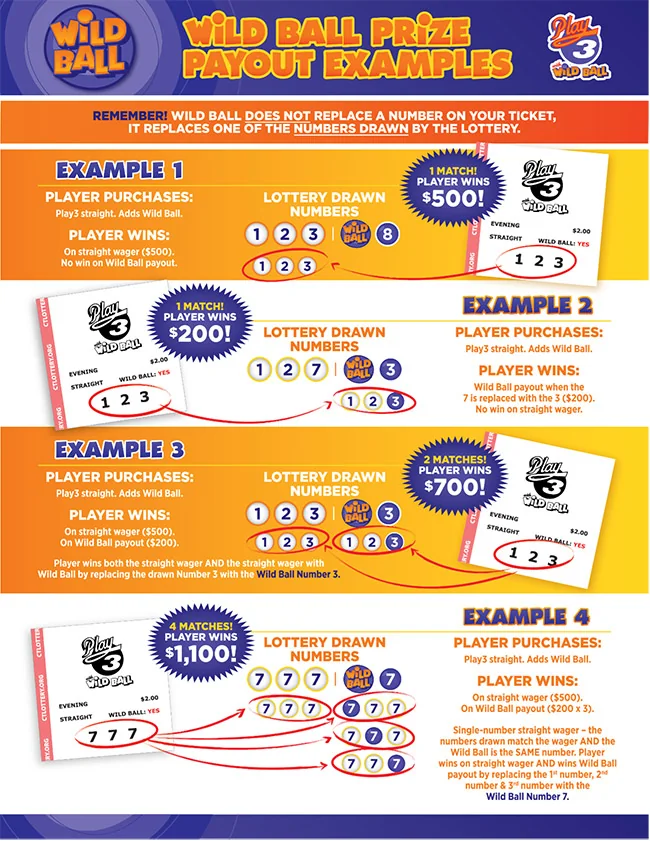
The official Connecticut explanation is precise: Wild Ball replaces one of the Lottery's drawn digits, not a number printed on your ticket. Each replacement creates a possible additional winning combination. Your original selection remains unchanged, and the ticket must actually include Wild Ball for its qualifying additional combinations to matter.
For a hypothetical Straight example, suppose the ticket is 246, the main result is 243 and Wild Ball is 6. Replacing one drawn position at a time produces 643, 263 and 246. The final combination matches the illustrative Straight selection. This example demonstrates the mechanism and does not report a current drawing or change the prize attached to a particular purchased stake.
A ticket without the paid feature is checked against the base drawing under its original rules. You cannot add Wild Ball after seeing the result, replace several inconvenient drawn positions at once or use it as permission to rewrite the ticket. When checking a Box or Pair wager, apply that wager's coverage to the qualifying Wild Ball combinations instead of borrowing the Straight matching rule.
Read Wild Ball prizes separately from base prizes
The Wild Ball table separates base wager, Wild Ball wager and total cost. A 50-cent base Straight with Wild Ball costs $1 in total, while a $1 base Straight with Wild Ball costs $2. Their listed Wild Ball Straight prizes are $100 and $200 respectively. Those figures belong to the additional Wild Ball category, not the ordinary base Straight prize table.
This explains why a $2 total receipt does not automatically mean you bought a $2 base Straight. Part of that spending may have purchased Wild Ball coverage. Inspect the printed stake and feature status, then consult both applicable tables. A possible base-game win and qualifying Wild Ball wins need their own evaluation; the exact number of payable combinations can depend on the drawn digits and purchased play style.
If a payout appears confusing, keep the ticket and the complete main-plus-Wild-Ball result together for official checking. A cropped screenshot showing only the extra digit cannot explain the whole wager. More covered outcomes do not guarantee that a particular ticket wins, and the added cost should remain inside the spending limit you set before purchase.
Use the Day and Night cutoffs in Eastern Time
The current official schedule lists the Day drawing at approximately 1:57 p.m. Eastern Time, with sales closing at 1:45 p.m. The Night drawing is approximately 10:29 p.m. Eastern Time, with sales closing at 10:20 p.m. Both sessions run daily. Drawing time and the purchase cutoff are separate deadlines; the later televised or posted result does not extend the earlier buying window.
Check the printed date and Day or Night label after purchase. A ticket for the next available drawing is not automatically an entry into a drawing whose sales have already closed. If you are outside Connecticut, translate the published Eastern Time schedule carefully and keep the game date attached to it. A device displaying another time zone should not decide which drawing a ticket covers.
Choosing both daily sessions creates two drawing entries. Two $1 base selections in both sessions cost $4 before optional features. Adding Wild Ball to every one of those entries doubles that example to $8. Future-draw options multiply the amount further. Read the complete printed purchase and its total rather than judging cost by the number of digit selections on the playslip.
The official page offers Advance Action for future drawings. Inspect the actual dates and sessions issued, especially when buying ahead around a weekend or holiday. A saved plan in a calendar is useful, but the issued ticket is the record of the purchased entry.
Finally, separate a scheduled drawing from an updated result display. The latest available record may still carry the previous drawing's date. If you are waiting for a new result, do not reuse the old number merely because the scheduled draw time has passed. Look for the matching dated record or use an official checking channel, without assuming a fixed posting delay this guide has not verified.
Check the full three-digit result and any Wild Ball
Use the exact drawing named on the ticket. The Play3 Day results and Play3 Night results are separate records. Begin with the game and date, then the session, before comparing the three main digits and any applicable Wild Ball. A familiar sequence in another session does not settle the entry you bought.
Connecticut's official Check My Numbers interface also separates date range, Day or Night, the entered digits, Wild Ball and play type. Those controls reflect different pieces of the wager. A broad date-range match can help locate a past appearance, but it does not prove that the ticket was entered for that appearance. Return to its printed drawing dates before considering a claim.
Keep zeros, dates and purchased sessions together
A hypothetical selection such as 007 has three positions. Do not shorten it to 7, drop either leading zero or replace the full selection with a pair wager simply because only one nonzero digit appears. Conversely, a pair's X position means that position is outside that specific pair wager; it is not the same as a selected zero.
Keep the Wild Ball digit separate from the three-digit main result. Seeing four digits in a display does not convert Play3 into Play4. First evaluate the main result under the purchased base play type, then evaluate qualifying Wild Ball combinations if the ticket includes that feature. Preserve the full dated display if you need help explaining a calculation.
The LotterySnap number checker compares numbers in available records. It does not authenticate barcodes, establish ticket ownership or calculate an official payable prize. Confirm any suspected winner with Connecticut's official channels and the original ticket. If a particular game or date is unavailable in a tool, use the official archive rather than selecting a superficially similar game.
Past-number records can help reconcile old entries. They cannot make a digit due, improve a random selection through a hot-number label or guarantee that a repeated sequence will stop appearing. Keep checking focused on the ticket already purchased, with each drawing evaluated under its actual rules and dates.
Keep your original ticket and follow Connecticut claim instructions
Sign and protect the original ticket. Connecticut identifies that original as the valid receipt for a prize claim; a website match or photograph is not a substitute. Keep a private copy for your records, but do not publish clear barcode, serial or signature details when asking other people about an apparent win.
The current Connecticut Lottery claim instructions set a 180-calendar-day period from the drawing for draw-game tickets. They separately describe mail-in claims as requiring a postmark within that period. Follow Connecticut's own wording and current instructions rather than copying a receipt deadline from another state. The purchase date, drawing date and date you noticed a match can be different.
For paper tickets, the official page allows prizes up to $599 to be claimed by mail or at a Connecticut retailer. Prizes from $600 through $5,000 can use a High-Tier Claim Center, headquarters or mail. The page also warns that retailers are not legally required to redeem a winner and may have cash restrictions. A store declining payment does not, by itself, cancel a valid prize or show that your number comparison was wrong.
Claims of $600 or more require the appropriate identification, including a government-issued photo ID and another valid form as specified by the Lottery. Obtain the current form, address and document list directly from the claim page before mailing. If visiting in person, confirm the destination's current hours and holiday schedule. Online account winnings have their own official claim guidance, so do not assume every paper-ticket procedure applies unchanged to an online purchase.
LotterySnap provides independent information and number comparison; it does not sell Connecticut entries or pay claims. Participate only when you meet the applicable age and location requirements, and keep purchases within a predetermined entertainment limit. If an amount remains disputed, retain the original ticket and the complete dated result for official assistance. This guide offers general information, not individual legal or tax advice or a guarantee of payment timing.

Loading comments...